 Image 1 of 5
 Image 2 of 5
 Image 3 of 5
 Image 4 of 5
 Image 5 of 5
More Seeds

Tulsi Basil is one of the most culturally important herbs for medicinal and spiritual uses in South Asia. This red leaf variety ‘Krishna’ has high levels of rosmarinic acid and eugenol, which lends to its clove-like scent. Regular consumption of tulsi not only helps protect and detoxify the body's cells and organs, it can also help reduce toxic stress by relaxing and calming the mind and offering many other psychological benefits.
Plants grow to a height of 20” at maturity with small, reddish purple leaves. Leaves can be used fresh or dried for tea. This variety is the most medicinal and spiritual of any other variety.
Numerous studies also show that tulsi has anti-diabetic, anti-bacterial, anti-carcinogenic, anti-fertility, anti-ulcer and many other activities. The compounds present in this herb help the body and mind cope with a wide range of chemical, physical, infectious and emotional stresses and restore physiological and psychological function.
Seeds can be tricky to start since they are extremely tiny and require light to germinate. We use seed starting soil in a wide pot (or a takeout container with holes at the bottom), and sprinkle the seeds over the top. Lighly sprinkle a little seed starting soil over the seeds, taking care to not bury to seeds. Be careful while watering, as seeds can easily get buried from the force of the water. Cover the pot with saran wrap and place in a sunny window or greenhouse. Keep soil moist until first signs of germination. Once plants are 1/2” tall, you can seperate them into individual containers to continue growing.
At least 200 seeds per Packet.
Ocimum sanctum (sometimes referred to as Ocimum tenuiflorum)
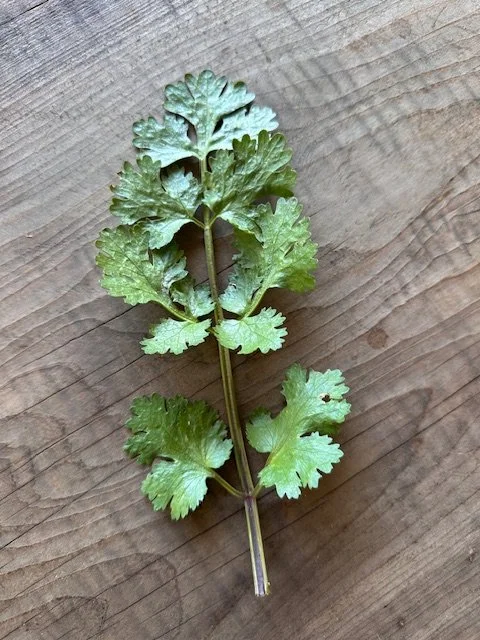
Dark green, deeply serrated and very aromatic variety of Cilantro. Our seeds are originally from Karachi, Pakistan. Compared to store bought cilantro, this variety is much more pungent and lends well to South Asian dishes.
Cilantro grows best in cooler weather. We plant our cilantro in early Spring or late Summer. If you wish to grow Cilantro in the Summer, it’s best to plant it in a location where it can receive some shade in the afternoon.
Minimum 150 seeds per packet.

Malabar spinach, also known as Poi, is a tropical vine native to the Indian Subcontinent. Other names it goes by are Vietnamese Spinach, Ceylon spinach, Basella, Saan Choy (Chinese); Tsuru Murasa Kai (Japanese); Mong Toi (Vietnamese); Paag-Prung (Thai); Genjerot, Jingga, Gendola (Indonesian); alugbati (Filipino).
Malabar Spinach is a fast growing, heat tolerant vine that can grow over 30 feet in length. The leaves have a mucilaginous texture with a slight lemon and pepper flavor. When cooked, the mucilaginous texture disappears and the flavor resembles spinach, but doesn’t wilt, as is common with spinach. Try them in Pakoda (Bhajia)!
It does best in a location with some slight shade and will continue to sprawl over a trellis through the years (Zone 10 only). Can be grown in containers. Red Stemmed berries can be used for dye.
Start seeds indoors 4 weeks before planting outside or wait until nighttime temperatures are above 50 degrees to direct seed.
25 seeds per packet.

An heirloom pepper variety originally from Hubli, India. These peppers are long (5-6”), thick walled and spicy. They’re the classic Indian chillies, an essential for any and all South Asian cooking.
The plant itself is extremely prolific, sending out dozens of chillies that go from green to orange to red, affecting the spice level with it. The is our most favorite pepper variety on the farm. Perfect for those who like to have a few spicy green peppers to munch on with their meals. We have also made a delicious achaar (Indian pickle) using these green peppers and green mango. When the peppers turn red we like to put them in the oven on the lowest heat to quickly dry them down and either blend them into a chilli powder or into chilli flakes. Highly recommend using the chilli flakes for a chilli crisp! They have the perfect heat and smokiness.
These seeds were gifted to us by one of our customers at the Irvington Farmers Market in Fremont. He brought them back from his hometown of Hubli, in the Southern State of Karnataka, India. We have been stewarding this variety for the past four years.
25 seeds per packet.